Episode 3: Does nature have intrinsic value?

In this episode, we ask whether nature has intrinsic value – value in its own right, not because someone values it or finds it useful. Drawing on environmental philosophy, we unpick arguments that intrinsic value lies in humans, sentient animals, all living organisms, species, ecosystems and biodiversity.

Tell us what you think. Where do you think intrinsic value lies in nature? Has this topic sent you down the same abyss as Jenny? Please leave us a comment below this post – we’ll be discussing these in our wrap-up episode from series 1.

Listen on Spotify, Apple Podcasts and YouTube.

Recommendations from Becky:

My website, rebeccanesbit.com, has lots of resources about conservation ethics. I have written an explanation of why I believe intrinsic value lies in sentient beings, created a video about the ‘last (wo)man’ thought experiment, and compiled links to further reading.

I also have some book recommendations for you, in order of size:
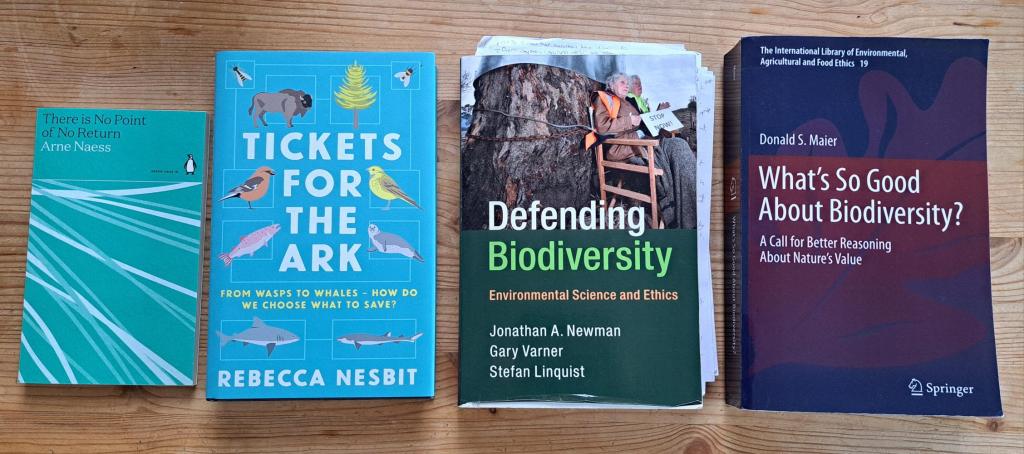
There is No Point of No Return – Although I don’t agree with Naess’s underlying philosophy, I appreciate his call for transformative change.

Tickets for the Ark – If you like Cat Among the Penguins, I think you’ll enjoy my book.

Defending Biodiversity – This book offers a valuable review of seminal work in environmental philosophy, as well as putting forward a reasoned argument. You can tell how important this has been to me by the notes sticking out of it!

What’s So Good About Biodiversity? – The first half of this huge book challenges existing arguments about the intrinsic value of biodiversity, and the second half proposes an alternative. The first half resonated with me, the second less so.

Recommendations from Jenny:

Sacred Nature – this book has helped shape Jenny’s thinking.

Jenny mentioned a New Scientist video about Homo sapiens interbreeding with Neanderthals and other species. You can also read more about the challenges of defining a species.

21 responses to “Episode 3: Does nature have intrinsic value?”

  1. Jonathan Newman Avatar
    Jonathan Newman

    One point that deserves more attention is the ambiguity in what ecologists mean when they say that ecosystems have “intrinsic value.” Sometimes the claim means simply that people value ecosystems for their own sake, rather than only for the services they provide. That is a plausible and important claim, but the reasons it generates remain dependent on the values of particular individuals or communities.

    At other times, “intrinsic value” is used in a much stronger sense: ecosystems are said to possess value independently of anyone’s attitudes, such that we have direct moral duties toward them and can wrong them by damaging them. That claim carries far greater moral force, but it also requires a much more substantial philosophical defence. Ecosystems are not conscious, do not have interests or a unified welfare, and are not obviously the kinds of entities for whom things can go better or worse.

    The problem is that ecologists often move between these meanings without marking the transition. They defend intrinsic value using the weaker and relatively uncontroversial claim that ecosystems are valued for their own sake, but then employ the term as though the stronger conclusion had been established—as though ecosystems possess objective moral standing and their protection imposes binding duties on everyone. The plausibility of the weaker definition is thereby used to borrow the moral authority of the stronger one.

    The distinction matters in practice. If ecosystem value is attitude-dependent, it may support conservation without overriding competing human or animal interests. If it is objective and duty-generating, then we need principles for deciding what happens when ecosystem integrity conflicts with human subsistence, animal welfare, cultural continuity, or other intrinsic values. Simply declaring all of these things intrinsically valuable does not tell us how such conflicts should be resolved.

    Ecologists therefore need to specify which conception they are using and accept its consequences. “Intrinsic value” should begin the ethical argument, not substitute for one.

    Liked by 1 person

    1. Hi Jonathon, thanks so much for listening and for providing your thoughts! Really interesting perspective and I think I had the same kind of feeling – this actually depends very heavily on terminology and how we are defining certain concepts. I know for a fact that for me defining the terminology used, specifically ‘value’ would likely change my standing on the question. And what makes this incredibly complex is that there is no right or wrong. It is entirely subjective, and could potentially garner 8 billion individual viewpoints and opinions, yet is also the underlying question that determines a lot of our decisions in conservation. No wonder conservation is such a complex world to navigate. We will bring your comments in to our wrap up episode so stick around for a few more weeks 🙂 We appreciate the support! Cheers, Jenny

      Liked by 1 person

  2. This was a really thought-provoking episode, thank you! So thought-provoking, in fact, that it’s taken me a week to actually write down some thoughts.

    I think Jonathan really hit the nail on the head regarding the confusion between “weak” (humans can value things for reasons other than what they can provide for us) and “strong” intrinsic value (things can have objective value that is somehow independent of human attitudes). I also think there are (at least) two other ambiguities in how we use the term value that make clarity on this issue hard to come by.

    First, can value exist without someone or something to value it? Jonathan’s “stronger” intrinsic value requires that value is independent of any valuer (and Rebecca’s introduction says that intrinsic value would remain if humans no longer existed, which implies this viewpoint). It seems to me that a value is a property of the mind, so I can’t really conceive how a value could exist without someone to do the valuing, but that doesn’t necessarily imply that only humans can have values. When Rebecca argues that sentient beings have value, but non-sentient life doesn’t, she suggests that it’s the capacity to value things that makes some organisms themselves valuable. So, you might argue that there is a middle path: if an organism values itself, then it is valuable.

    A bigger, woollier problem is what do we even mean by “value”? I daresay there are infinite subtly differing definitions but we tend to use the word in two major ways: something akin to economic value or something more like moral value. Unfortunately the ways in which we reason about and discuss these concepts are often very different. Economic value doesn’t just mean money, but does imply something that can be measured, quantified, compared and exchanged. Even slime molds can assess two different food sources and choose between them, suggesting that they can assign values to things (nutritious value, in this case). Studies of kin selection in many species can be interpreted as animals assigning value to their lives and the lives of others based on the degree to which they share genes (I recently came across a good quote from J.B.S. Haldane to the effect that he would “gladly lay down my life for two brothers or eight cousins”!) All organisms take some form of action to preserve their own lives, so you could argue that even non-conscious organisms can value their own lives in this sense.

    I think a lot of people would find this dissatisfying: “this bacterium has intrinsic value because by taking in nutrients it demonstrates that it values its life”, is probably not a winning argument. Implicit in the discussion is that “value” has some sort of higher meaning, implying as Jonathan says, a moral duty of some sort toward the valued object. So does a being need to have a concept of morality, before it can hold moral values? If so, then mere sentience may not be enough to imbue an organism with value.

    Addressing these ambiguities is important because we run into issues when different values come into conflict. People tend to regard moral values as fundamentally different from economic values: it may be considered offensive or even inconceivable to try to compare, exchange or choose between two beings that have intrinsic value, but in a world under rapidly increasing ecological pressure, we can’t afford to declare such discussions off-limits.

    Liked by 1 person

    1. HI Joe, thanks so much for listening and for your thoughts! I am delighted to hear you have ventured down many of the same rabbit holes I did. Can value exist without a valuer was one of my key ones. For the sake of our sanity and producing a coherent episode, we had to cut a lot of our rabbit holes down/out. But this was where I got stuck. Everything that exists naturally in the world must be “valuable” to something or it wouldn’t exist in nature, a rock is incredibly valuable to the lichen that grows on it. But this depends on how we define “valuable.” Some arguments of this seem to indicate this being a little more like having rights, in other words, “should be protected from anthropogenically induced suffering.” Which to me, is different to value as it is only necessary to consider in the face of anthropogenic pressures, thus not intrinsic. Either value exists and must therefore be held by everything that exists in nature, or it doesn’t exist and therefore nothing is valuable. Cue many weeks of sleepless nights and us attempting to form some kind of structured episode that didn’t dissolve in to debate. We will likely talk about this a little more in our wrap up episode so be sure to stick around for a few more episodes! Thanks for the support! Jenny

      Like

      1. Jonathan Newman Avatar
        Jonathan Newman

        Jenny, I think your reply brings out several distinctions that may help prevent the discussion from collapsing into the conclusion that either everything has intrinsic value or nothing does.

        A rock may be valuable to a lichen because it provides a substrate on which the lichen can grow. That establishes a relationship of dependence or usefulness, but it does not show that the rock is itself the bearer of independent moral value. Nor does the fact that an organism depends on particular conditions mean that those conditions “value” the organism, or that everything involved in the relationship has value in the same sense. We need to distinguish something being valuable to a being from something having value for its own sake.

        There is then a further distinction between recognizing that something has value and concluding that its value generates duties for moral agents. Even if we say that an ecosystem, organism, species, or rock has some form of value independent of human usefulness, it does not automatically follow that moral agents are obligated to protect it. That conclusion requires an additional argument explaining why this kind of value places claims upon us.

        Finally, having duties concerning something is not necessarily the same as having duties to it. We may have strong reasons to protect a rock formation, an ecosystem, or a lichen community because of its importance to sentient beings, future people, scientific understanding, cultural relationships, or ecological processes. But those duties need not be owed directly to the rock or ecosystem itself. To claim that they are, we would need to show that the entity is an independent bearer of moral standing.

        This is also why I would resist equating intrinsic value with having rights or with being protected from anthropogenic harm. Rights are not simply another name for value. They are particularly strong moral claims that constrain what others may do, and they therefore require a theory of who or what can hold such claims and why. Similarly, the fact that a duty becomes relevant only when humans threaten to cause harm does not make the underlying value non-intrinsic. My interest in avoiding another being’s suffering may arise only when I am in a position to cause it, but the badness of that suffering does not therefore depend on my attitude toward it.

        So I do not think the alternatives are that everything in nature must possess intrinsic moral value or that nothing does. We can instead ask a sequence of more discriminating questions: valuable to whom or what, valuable in what sense, borne by which entity, and capable of generating what duties? My concern is that ecological discussions often move among these questions without noticing that they are making different philosophical claims.

        Liked by 1 person

      2. I think for me I don’t see a pathway in this conversation that wouldn’t lead me to the same thought. However long these discussions last, the underlying fact remains that whatever reason we find for “deciding” or ascribing intrinsic value to something – this is a human decision that is based around a human (and largely western) values system. No matter the sequential questions we ask, there is no point at which nature will step in and correct or validate our decisions and tell us what does and does not have value. It will be us that is deciding.

        And I can’t help but feel that if it does not equate to rights, or how we do or do not protect something, then what practical meaning does it have? If we decide unanimously across the globe that value lies in sentience, then what will this mean. If it means we treat sentient beings differently to non-sentient (based of course, on our current scientific understanding of sentience, which is ever evolving) then this does become more close to something having rights. If it does not equate to rights then presumably I can treat a chimp and a rock the same. Or, I can treat a chimp one way, but not the other things that the chimp may rely on to survive.

        I keep coming back to the fact that if human beings were to evaporate from the planet tomorrow, nature would just exist and everything that needed to exist in nature, would. ‘Value’ would not exist or be considered by any species other than humans. Value seems to only become relevant when it comes to how humans decide to treat nature. Without us, everything just is, and would be allowed to exist as it is. Life would continue in whatever form was the most suited to the environmental conditions, and evolve naturally with time and atmospheric changes. Species would come and go, individuals would live and die, experiencing the world in which ever way they have evolved to do so, be it using senses we understand thoroughly or those we have never even discovered. Everything would eat what it needed to eat, by and large organisms wouldn’t hurt or destroy anything for fun or pleasure (with the possible exception of some odontocetes and primates….), only as a survival resource. No species, even those deemed highly intelligent or sentient, would be making sweeping decisions about what is valuable and what isn’t – if it is ‘valuable’ in nature, then it will exist. That is surely how nature decides upon value?

        Like

  3. This was a really thought-provoking episode, thank you! So thought-provoking, in fact, that it’s taken me a week to actually write down some thoughts.

    I think Jonathan really hit the nail on the head regarding the confusion between “weak” (humans can value things for reasons other than what they can provide for us) and “strong” intrinsic value (things can have objective value that is somehow independent of human attitudes). I also think there are (at least) two other ambiguities in how we use the term value that make clarity on this issue hard to come by.

    First, can value exist without someone or something to value it? Jonathan’s “stronger” intrinsic value requires that value is independent of any valuer (and Rebecca’s introduction says that intrinsic value would remain if humans no longer existed, which implies this viewpoint). It seems to me that a value is a property of the mind, so I can’t really conceive how a value could exist without someone to do the valuing, but that doesn’t necessarily imply that only humans can have values. When Rebecca argues that sentient beings have value, but non-sentient life doesn’t, she suggests that it’s the capacity to value things that makes some organisms themselves valuable. So, you might argue that there is a middle path: if an organism values itself, then it is valuable.

    A bigger, woollier problem is what do we even mean by “value”? I daresay there are infinite subtly differing definitions but we tend to use the word in two major ways: something akin to economic value or something more like moral value. Unfortunately the ways in which we reason about and discuss these concepts are often very different.

    Economic value doesn’t just mean money, but does imply something that can be measured, quantified, compared and exchanged. Even slime molds can assess two different food sources and choose between them, suggesting that they can assign values to things (nutritious value, in this case). Studies of kin selection in many species can be interpreted as animals assigning value to their lives and the lives of others based on the degree to which they share genes (I recently came across a good quote from J.B.S. Haldane to the effect that he would “gladly lay down my life for two brothers or eight cousins”!) All organisms take some form of action to preserve their own lives, so you could argue that even non-conscious organisms can value their own lives in this sense.

    I think a lot of people would find this dissatisfying: “this bacterium has intrinsic value because by taking in nutrients it demonstrates that it values its life”, is probably not a winning argument. Implicit in the discussion is that “value” has some sort of higher meaning, implying as Jonathan says, a moral duty of some sort toward the valued object. So does a being need to have a concept of morality, before it can hold moral values? If so, then mere sentience may not be enough to imbue an organism with value.

    Addressing these ambiguities is important because we run into issues when different values come into conflict. People tend to regard moral values as fundamentally different from economic values: it may be considered offensive or even inconceivable to try to compare, exchange or choose between two beings that have intrinsic value, but in a world under rapidly increasing ecological pressure, we can’t afford to declare such discussions off-limits.

    Like

  4. Jonathan Newman Avatar
    Jonathan Newman

    I think we could summarize the discussion so far by distinguishing several claims that are often treated as interchangeable.

    First, there is a philosophical difference between saying that something or someone has value and saying that this value generates duties for moral agents. We may judge something to be valuable without concluding that anyone is therefore obligated to protect it, preserve it, or promote it. Moving from a claim about value to a claim about duty requires an additional moral argument: we need to explain why that kind of value places demands on the conduct of moral agents.

    Second, there is a potentially important difference between saying that moral agents have duties toward something and saying that the thing itself is the bearer of independent moral value. I may have duties concerning an object, place, species, or ecosystem without those duties being owed directly to that entity. The duties might instead arise from what it means to other moral patients, from commitments we have made, from considerations of justice, or from the consequences of its destruction for present and future beings.

    This is especially important in debates about the intrinsic value of ecosystems. To say that an ecosystem has value independently of its usefulness to humans does not yet establish that it is an independent bearer of moral value, much less that moral agents owe duties directly to it. Duties to protect ecosystems may instead be grounded in the interests of sentient animals, the claims of present and future people, obligations of justice, or the importance of preserving the conditions that sustain valuable forms of life. The argument therefore cannot simply move from “ecosystems have intrinsic value” to “we have duties to ecosystems.” It must explain what kind of value is being claimed, whether the ecosystem itself has moral standing, and how that standing generates duties that are not reducible to duties owed to the beings who depend upon it.

    Liked by 1 person

    1. Thank you, Jonathan, for your clarity of thought on the differences between value, moral standing and moral duties. We’re probably having an unusually academic (read: non-emotional) discussion on this subject, but I suspect most people who would talk about “intrinsic value” do actually mean “bearing independent moral value that generates moral duties for humans”.

      Given that we can’t seem to agree on a definition for “intrinsic” or “value”, I’m in favour of dropping the term entirely and talking instead about what we really mean. Moral rights may not be same thing as intrinsic value, but I get the feeling that when people argue that something has intrinsic value, they are almost always doing so to try to establish that it has rights and/or that we all have moral duties toward it.

      I’ve long thought that when we talk about an entity having rights, we are really talking about our moral duties toward it, but I’ll save that for an episode that’s actually about rights.

      Like

      1. Funnily enough, I feel we may have reached the same conclusion. I think we are far too blinded by our own values to even realise how deeply embedded they are, even in conversations like this, let alone the conservation decisions that may arise from conversations like this. We recognise ourselves in sentience, therefore we value animals that experience that. We don’t recognise other ways of experiencing the planet, therefore we don’t “value” it. Although this in itself is a sweeping and very Western statement. Plenty of other cultures would strongly disagree. In Western culture, we are not able to separate ourselves enough from our own values to see that we are operating on every level from a deep rooted value system. Thus whatever conclusion we reach will be based on a framework of values, but we will never all be in agreement. Even the fact that it can be this subjective tells me that we are talking about human values.

        And, the ultimate outcome will be a change in how we treat nature. We will develop our moral code based on what we decide has intrinsic value. But to think about these questions we have to be really willing to deeply embrace other points of view, other cultures and other ways of looking at things. Which differ very very dramatically from what western science has always taught us to value or believe. In many indigenous cultures they language they use for non-human beings, even down to rocks, mirrors the language they use for human family members. They describe them the same way, as “they.” The “tree-people” or the “rock-people.” If these elements of the natural world are so deeply valued by other members of the human population, who are we to decide they are not valuable?

        For it to be truly intrinsic, it must be free of any human valuation at all. In short, humans cannot be the ones making this decision. In the absence of any non-human species having the capacity to discuss philosophical arguments (at least in a language we understand…), we have to assume nature has other ways of “making decisions.” Thus, we remove ourselves and see what nature “decides.” In this situation, sentient beings would not have preferential treatment, they would be provided for, as would flatworms, microbes, viruses. They would exist when they existed, and die when they die. Genes would shift, ecosystems would alter, no non-human species would develop a moral code. Deciding on what has intrinsic value does not feel like a job for humans. Deciding on what we value, and therefore how we behave, is a very big and very important job for humans.

        Like

  5. It’s interesting that different conceptions of value are a key part of discussion here – as Jenny says, this was a major cause for a spiral. Our starting point was me being familiar with (and convinced by) Jonathan’s line of reasoning, while Jenny was more thinking along the lines of Joe’s point when he says:

    “Even slime molds can assess two different food sources and choose between them, suggesting that they can assign values to things (nutritious value, in this case).”

    Cue Jenny’s example of the lichen and the rock. 

    I think we first need to distinguish between the value lying in the ‘valuer’ and in what is ‘valued’. If the lichen was sentient, based on the language that Jonathan and I are using, the rock would have instrumental value not intrinsic value. If we are including instrumental value in the shorthand of ‘value’, yes pretty much everything is valuable, because it is useful to something else. That’s not intrinsic value though. 

    I like to use my guinea pig as an example. We could say:

    “Midget values a dandelion, which values soil organisms, which value rainwater.”

    Or we could phrase it as:

    “Midget takes pleasure from a dandelion, which can grow because of soil organisms, which requie rainwater to keep them alive.”

    In the first wording, Midget is the one thing that isn’t valued. But the second wording shows why she has intrinsic value yet the dandelion and rainwater only have instrumental value – she’s can have a positive or negative experience. She’s the only one with the capacity to care what’s going on here. 

    She doesn’t have any concept of intrinsic value – I just went out to give her some dandelion and I asked her about intrinsic value. She didn’t respond. Yet her capacity to experience the world would remain even if humans were extinct and nobody was there to think about value. This conception of intrinsic value therefore doesn’t rely on the existence of a moral being to do the valuing. Intrinsic value is a property of all sentient beings, not of human reasoning. 

    Liked by 1 person

    1. I enjoy your guinea pig example: it’s both clarified and confused matters for me! It seems like you are combining both disputed meanings of “intrinsic”: both to mean a value held by a conscious mind that is not purely instrumental (the value of the dandelion to Midget), and a value that is independent of any and all conscious minds (Midget’s own value).

      The difference between Midget valuing the dandelion and soil microbes valuing water, in your telling, is that Midget derives pleasure from the dandelion. Of course, we can’t actually know whether Midget really gets pleasure from dandelions; or whether that pleasure is comparable to the pleasure I might derive from eating, say, a nice roast guinea pig; and we can’t rule out the possibility that even microbes get something describable as pleasure from water. I suspect that both consciousness and hedonic experiences are more of a sliding scale than a binary, and that there are edge cases where the dividing line between enjoyment and purely instrumental value is impossible to place.

      Still, I can provisionally accept a new definition of intrinsic value: anything that experiences pleasure (or experiences anything at all?) has intrinsic value. The problem is that it leaves some big questions unresolved. First, where does the value lie? Sure, entities meeting this definition have value to you, but is it meaningful to say that they have value independently of you? If humans disappeared overnight, Midget would still enjoy dandelions, but does she still have value?

      Which brings me to the next issue: why even describe this as value? Why not just state that beings that have conscious experience constitute a special class of beings? I can’t help but feel that the main reason for declaring Midget has intrinsic value is to establish her as being imbued with moral value, and thus deserving of our moral consideration; and that claiming the value is intrinsic mainly has the effect of declaring our moral duties toward Midget to be objective, and so not open to debate as they would be if she merely had value to you. And Jonathan has eloquently explained how this is skipping several steps of moral reasoning. If that’s not the intention then I can’t see that “Midget has intrinsic value” is a more useful assertion than “Midget enjoys eating dandelions”.

      Liked by 1 person

      1. That’s an interesting way of making a clarification, when you say: ‘It seems like you are combining both disputed meanings of “intrinsic”: both to mean a value held by a conscious mind that is not purely instrumental (the value of the dandelion to Midget), and a value that is independent of any and all conscious minds (Midget’s own value).’

        I think what I was really trying to convey was that intrinsic value is a property of a conscious mind. That value doesn’t require an independent valuer, human or otherwise. The conscious mind can derive value from all sorts of things, including other conscious minds, but these values are lost once the conscious mind is lost. I think that’s the key question – does the value survive if there is no valuer?

        In answer to your question “If humans disappeared overnight, Midget would still enjoy dandelions, but does she still have value?” I think ‘yes’. Midget’s ability to feel pleasure and pain isn’t dependent on humans.

        I completely agree with your first statement here: “I suspect that both consciousness and hedonic experiences are more of a sliding scale than a binary, and that there are edge cases where the dividing line between enjoyment and purely instrumental value is impossible to place.” And yes, I think that humans don’t have the knowledge to work out where intrinsic value is (and it’s unlikely they ever will).

        On a connected point, I agree with the premise: “…we can’t actually know whether Midget really gets pleasure from dandelions; or whether that pleasure is comparable to the pleasure I might derive from eating, say, a nice roast guinea pig…”. However, in this specific case I am confident you would gain no pleasure from eating Midget.

        Interesting thoughts, thank you!

        Like

  6. As Jonathan says, moral duties is a separate topic. That’s where human valuations come in – human rights are a social code to agree on, not a property of the universe that we need to discover. This is another fascinating rabbit hole to go down – how should we act towards other sentient beings? I just took a break to feed Midget – how do we trade off her love of dandelion with my spiralling desire to write comments about intrinsic value?!

    Thank you very much for the comments – I look forward to discussing them in the Series 1 wrap-up (particularly because I have faith that Jenny and I now know how to record an episode about this without spending days and nights wading through the abyss).

    Liked by 1 person

  7. ghostlycat6f22e831d0 Avatar
    ghostlycat6f22e831d0

    I thought this might be a helpful review of intrinsic value.

    One reason debates about the “intrinsic value of ecosystems” become confused is that the term can refer to several quite different ideas, with very different moral implications.

    At the weakest end is subjective intrinsic value: people can have intrinsic value judgments about ecosystems for what they are, rather than merely for what ecosystems provide us. This is plainly true. People routinely have intrinsic value judgments about forests, wetlands, species assemblages, and landscapes for their own sake. But the resulting considerations remain dependent on human attitudes. The ecosystem matters because people assign it intrinsic value, not because it independently makes moral claims upon us.

    A somewhat stronger family of views treats intrinsic value as relational. Intrinsic value arises through interactions between features of the natural world and human psychology. Some of these relationships are highly personal; others are culturally shared. A particular landscape may therefore have profound intrinsic value for an individual or community. Such intrinsic value can generate substantial moral reasons for protection, but it does not automatically establish a universal claim that everyone ought to assign the same intrinsic value to that ecosystem. One could imagine a still stronger relational account in which humans are psychologically predisposed to assign similar intrinsic value to certain natural entities in broadly similar ways, but persistent disagreement about the intrinsic value of ecosystems makes this difficult to defend.

    The strongest conception is objective intrinsic value. On this view, intrinsic value is a property of the world itself: ecosystems possess intrinsic value independently of whether anyone recognizes or assigns intrinsic value to them. This is the conception capable of doing the greatest moral work. If ecosystems possess objective intrinsic value, they may be candidates for direct moral standing and we may have duties to them, rather than merely reasons to protect them because of their importance to humans or sentient animals.

    But it is also the most philosophically demanding claim. It requires both an account of how intrinsic value can exist independently of valuers and an explanation of what properties of ecosystems could make them bearers of that intrinsic value.

    The important point, therefore, is that “ecosystems have intrinsic value” does not express a single proposition. It can range from the highly plausible claim that humans assign intrinsic value to ecosystems non-instrumentally to the much stronger and more controversial claim that ecosystems possess objective moral standing. Those claims should not be allowed to borrow support from one another. Before intrinsic value can do any work in conservation ethics, we need to say which kind of intrinsic value we mean—and what moral consequences actually follow from it.

    Liked by 1 person

    1. Thank you, this is an interesting clarification! For me then, the only one of these which is intrinsic would be objective intrinsic value. Everything else is rooted in a value to humans. If the claim to value is based on humans like it or don’t like it, it is significant to a community, etc, then it is not intrinsic. If it is intrinsic and presents non-human entities as candidates for having independent moral standing then the point remains that what is left to be decided is how we move forward as humans treating said candidate. Seeing as we can’t even reach a global conclusion on basic human rights, it feels like we probably have a long way to go in progressing this.

      A rise in situations such as communities gaining recognition for certain natural areas or species as having rights is promising and shows what can be achieved. But the fact remains that in every situation this has been achieved by a small group of humans who deeply value something and are willing to fight for it. So, for me the question is, does intrinsic value matter? What matters, and what really moves the needle forward in terms of actual, actioned conservation, is human values. Things we have decided are important, and we have been dedicated enough to fight for. Perhaps we don’t need to spend time arguing about where intrinsic value lies, when possibly the most powerful thing we can do is embrace our very closely held human values, and use them to drive the change we want to see.

      Like

      1. ghostlycat6f22e831d0 Avatar
        ghostlycat6f22e831d0

        I think the distinction between instrumental and intrinsic value is still useful, Jenny, even if both are ultimately human value judgements. It means something importantly different to say, “I value this because it is useful to me” and “I value this for what it is, independently of what it does for me.” A forest valued for timber, carbon storage, or recreation is being valued instrumentally; a forest valued simply because one thinks its existence is worthwhile is being valued intrinsically. Neither claim requires us to say that the forest possesses objective, mind-independent value. But distinguishing them still tells us something important about why people value nature—and therefore about the kinds of reasons that motivate conservation.

        (This is Jonathan Newman, by the way. WordPress made me make a profile and then assigned me this weird user name that I can’t figure out how to change!)

        Liked by 1 person

      2. Oh haha hello, well I like the undercover approach! Yes I completely agree with this – I suppose the question gravitates again back to the meaning of the term intrinsic which I think seems to be my sticking point. Differentiating between the different reasons humans value nature is very important, and acknowledging the huge value that lies in nature aside from resources and economic gain is essential. I still see this as different to intrinsic value, but it likely all comes down to different definitions of intrinsic.

        Liked by 1 person

    2. Interesting discussions, and I think the difference between subjective and objective intrinsic value is an important one (thank you ghostlycat – I had a feeling that you were undercover Jonathan!). I think it might be where a lot of confusion comes from. Most people making vague statements about nature having intrinsic value haven’t picked this apart. I would like different words for subjective and objective intrinsic value, to avoid the confusion. Jonathan, you have used ‘existence value’ in the past, what about something like that?

      Like

  8. ghostlycat6f22e831d0 Avatar
    ghostlycat6f22e831d0

    Yes, I think existence value is useful here, Rebecca, although it comes with a bit of conceptual baggage of its own. It is originally an economics concept, usually treated as a form of non-use value: I can value the continued existence of a species, ecosystem or wilderness even if I never use it, visit it, or expect to benefit from it directly. The US National Oceanic and Atmospheric Administration, for example, defines it in terms of the value people derive simply from knowing that a resource exists.

    In that sense, existence value maps quite closely onto what I have been calling subjective intrinsic value. I can value a forest for its own sake rather than for timber, recreation, carbon storage, etc. But it is still my valuation of the forest. Its existence value, in the economic sense, depends upon there being people who care that it exists.

    That makes it importantly different from objective intrinsic value, where the claim is that the forest possesses value in itself whether or not anyone values it. So perhaps “existence value” would actually help with the terminology: it captures the perfectly coherent idea that humans can value nature non-instrumentally without smuggling in the much stronger claim that nature possesses mind-independent moral value.

    The slightly ironic part is that economics may therefore give us cleaner terminology for this distinction than environmental ethics has!

    Liked by 1 person

  9. […] became excited by this question in Episode 3 when we were talking about the intrinsic value of nature. Was it a good conservation strategy to […]

    Like

Leave a comment